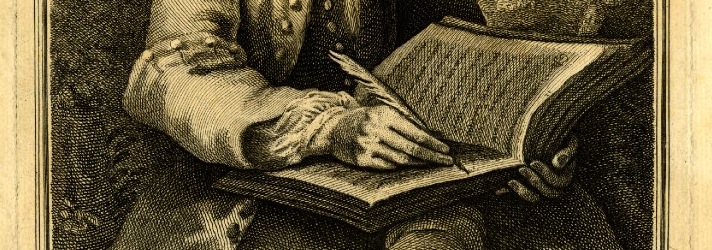
Walter Harte, “A Soliloquy, Occasion’d by the Chirping of a Grasshopper”

WALTER HARTE

“A Soliloquy, Occasion’d by the Chirping of a Grasshopper”

Happy Insect! ever blest
With a more than mortal rest,
Rosy dews the leaves among,
Humble joys, and gentle song!
Wretched Poet! ever curst,                         5
With a life of lives the worst,
Sad despondence, restless fears,
Endless jealousies and tears.

In the burning summer, thou
Warblest on the verdant bough,               10
Meditating chearful play,
Mindless of the piercing ray;
Scorch’d in Cupid’s fervors, I
Ever weep, and ever die.

Proud to gratify thy will,                      15
Ready nature waits thee still:
Balmy wines to thee she pours,
Weeping thro’ the dewy flow’rs:
Rich as those by Hebe giv’n
To the thirsty sons of heav’n.                    20

Yet alas! we both agree,
Miserable thou like me!
Each alike in youth rehearses
Gentle strains, and tender verses;
Ever wand’ring far from home;                 25
Mindless of the days to come,
(Such as aged winter brings
Trembling on his icy wings)
Both alike at last we die;
Thou art starv’d, and so am I!                     30

NOTES:

13 Cupid’s fervors The Roman god of love, here referenced in the context of trying to write romantic love poetry.

19 Hebe Greek goddess of youth; she was cupbearer to the gods on Olympus, serving them ambrosia.

Source: Poems on Several Occasions (London, 1727), pp. 80-2. [ECCO]

Edited by Bill Christmas

Mary Masters, “On seeing a Lady…”


MARY MASTERS

“On seeing a Lady with a new fashion’d Riding-Dress, and a Hat cock’d up”

The Round-ear’d Cap (once worn with decent Pride)
And Velvet Bonnet both are thrown aside;
The Beaver, now, cock’d up with bolder Air,
And manly Habit, please the fickle Fair.
Yet, for Excuse, it justly may be said,                                                5
A Scheme with deepest Policy is laid:
Since, among Men, there is a stupid Race,
Who slight the Graces of the Female Face:
Since Fops so long have self-enamour’d been,
And view the Mirror with a raptur’d Mien;                                       10
They hope in this Disguise each Beau to charm,
And win th’ Apostates with a mimick Form.
With happy Art so justly they improve,
Sure all must now the Manlike Beauties love.


NOTES:

Title Riding-Dress, and a Hat cock’d up The female riding habit dates from the 1660s, and was usually comprised of a jacket and waistcoat in imitation of men’s fashion at the time, with a similar cravat worn at the neck, a periwig and cocked hat on the head, and full skirts and petticoats. Criticism of this androgynous female fashion came from influential literary men like Joseph Addison, Richard Steele, John Gay, Samuel Richardson, and Horace Walpole through the first half of the century, and popular periodicals like the London Journal and the Gentleman’s Magazine inveighed against the practice in the 1730s.

1 Round-ear’d cap Headwear for women, made of linen or cotton, that curved around the head to cover the ears and edged with lace or ruffles; fashionable in the early decades of the eighteenth century.

3 Beaver…cock’d up A hat made of felted beaver fur, with the brim folded up; probably a reference to the popular tri-corner style hat.

9 Fops A derogatory term for a vain, dandyish man.

11 Beau A handsome, fashionable young man; here a synonym for “fop.”

12 Apostates Those who have abandoned their religious faith, political allegiances, or principles in general.

SOURCE: Poems on Several Occasions (London, 1733), pp. 157-8.

Edited by Bill Christmas